The data
Real, uncapped listening, and why the small set was a trap.
The served model is trained on Last.fm-360K: real, organic listening histories. Getting here required abandoning an earlier, smaller dataset whose shape quietly distorted every result.
The served dataset, Last.fm-360K
We filter the raw dump to a recommendable core: users with enough history to learn from, and artists with at least 100 distinct listeners (below which collaborative filtering has almost nothing to work with).
39,499
users
11,607
artists
1.68M
interactions
0.37%
density (99.6% sparse)
Each user brings a median of 44 artists, genuine histories, not a truncated top-list. The 99.6% sparsity is the normal regime for collaborative filtering, not an artifact.
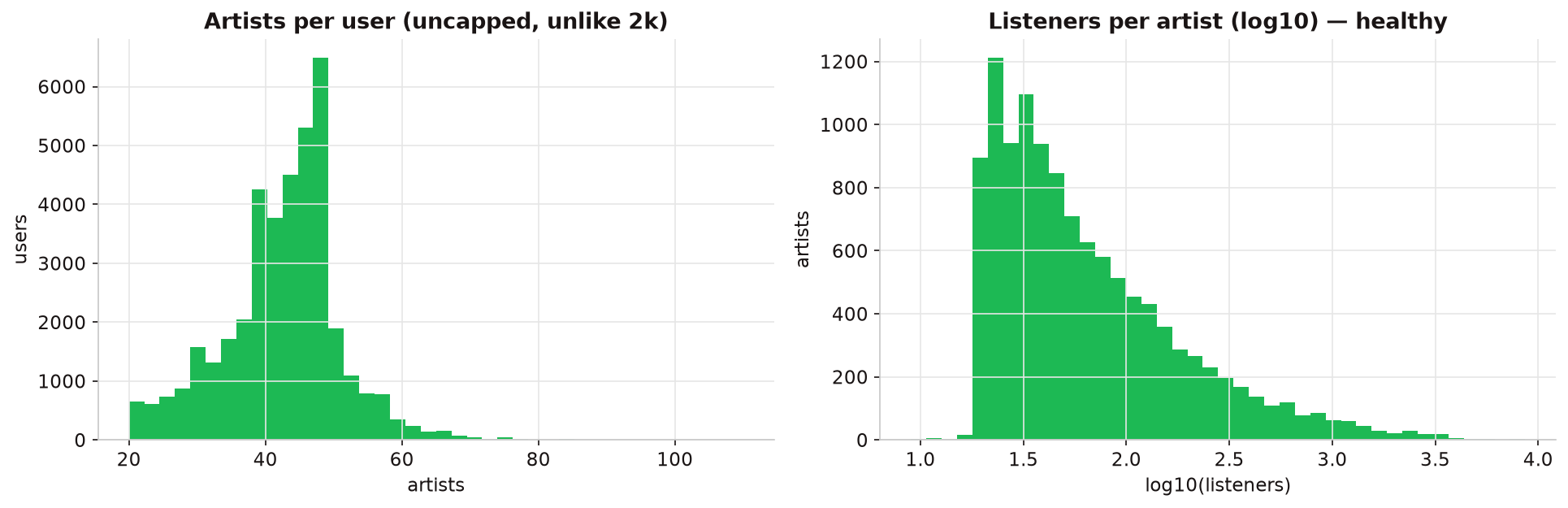
The signal is implicit
The only signal is a play count per (user, artist), there are no explicit ratings. Play counts span roughly six orders of magnitude (1 to ~220,000), so treating them as graded ratings and chasing RMSE would optimise magnitude, not preference rank. Instead we model them as implicit confidence and evaluate with ranking metrics.
Listening is extremely concentrated
A Lorenz curve of artist popularity makes the core modelling tension visible: a small set of artists absorbs most of the listening. This is why a popularity baseline is genuinely hard to beat, and why catalog coverage is a real product concern, not a vanity metric.
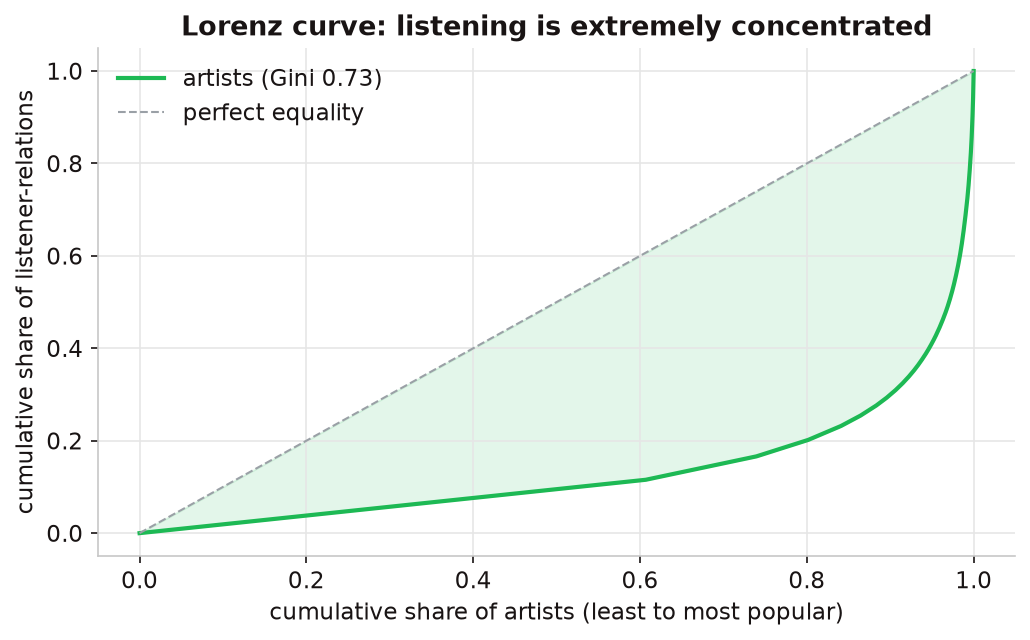
The live app recomputes all of these statistics directly from the served matrix, so the numbers there always match the data the model is actually trained on.
Why not the small 2k set?
The project began on Last.fm-2k (HetRec 2011): 1,892 users, 17,632 artists. It looked convenient, but it had two structural defects that quietly distorted everything:
- Every user was hard-capped at their top ~50 artists. The “sparsity” was therefore an artifact of truncation, not a property of real behaviour.
- ~61% of artists had a single listener (Gini ≈ 0.73). Those artists are near-unrecommendable, collaborative filtering has nothing to learn for them, which caps achievable recall and depresses every score.
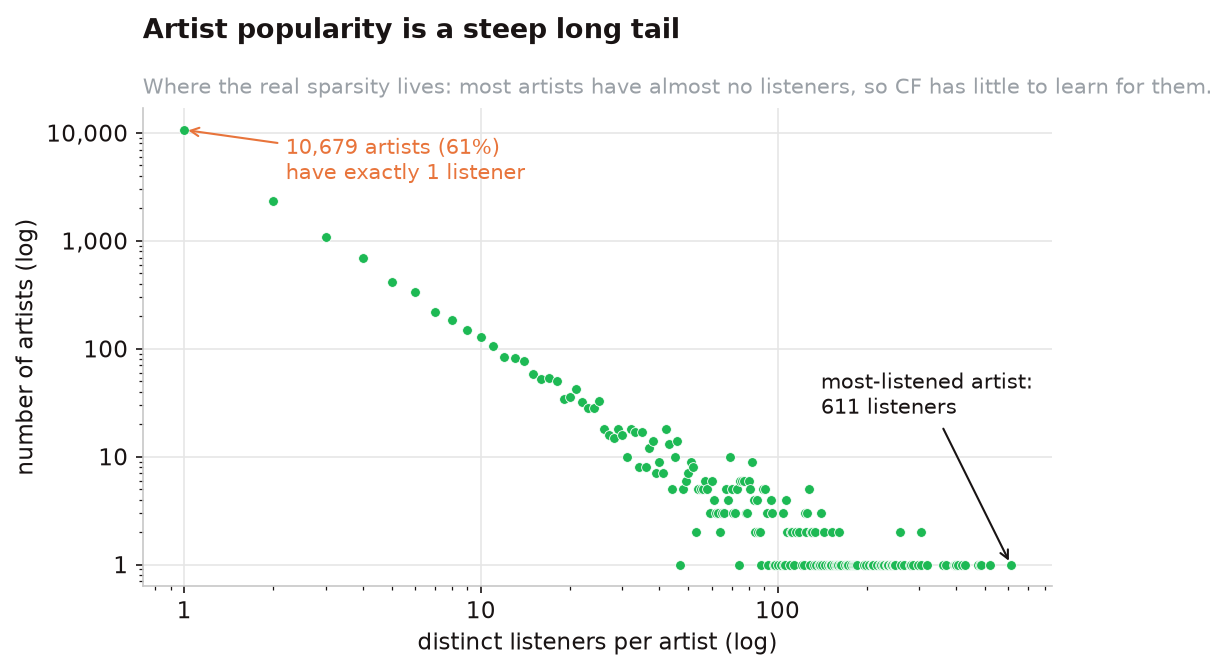
That artificial shape is precisely why we pivoted to 360K, and, as the pivot page shows, why the winning model changed once real data arrived.