The pivot
Why the served model changed from ALS to EASE.
The most instructive result in this project is that the winning model changed when the data changed. That is not a flaw in the method, it is the method working. Because the harness stayed frozen across both phases, we can trust two opposite conclusions.
Phase 1, small data (Last.fm-2k)
On the tiny, heavily-capped 2k set, we pitted a deep Mult-VAE and a linear EASE autoencoder against a well-tuned ALS, all through the same frozen split and metrics.
| Model | NDCG@10 | vs ALS |
|---|---|---|
| ALS (chosen) | 0.171 | , |
| EASE | 0.169 | not significant (p = 0.41) |
| Mult-VAE (deep) | 0.158 | ALS wins, p < 0.001 |
The deep model lost significantly, and EASE’s millions of parameters bought nothing over a small ALS. This is exactly the Ferrari Dacrema et al. (2019) finding: on small, sparse data, complexity is not free.
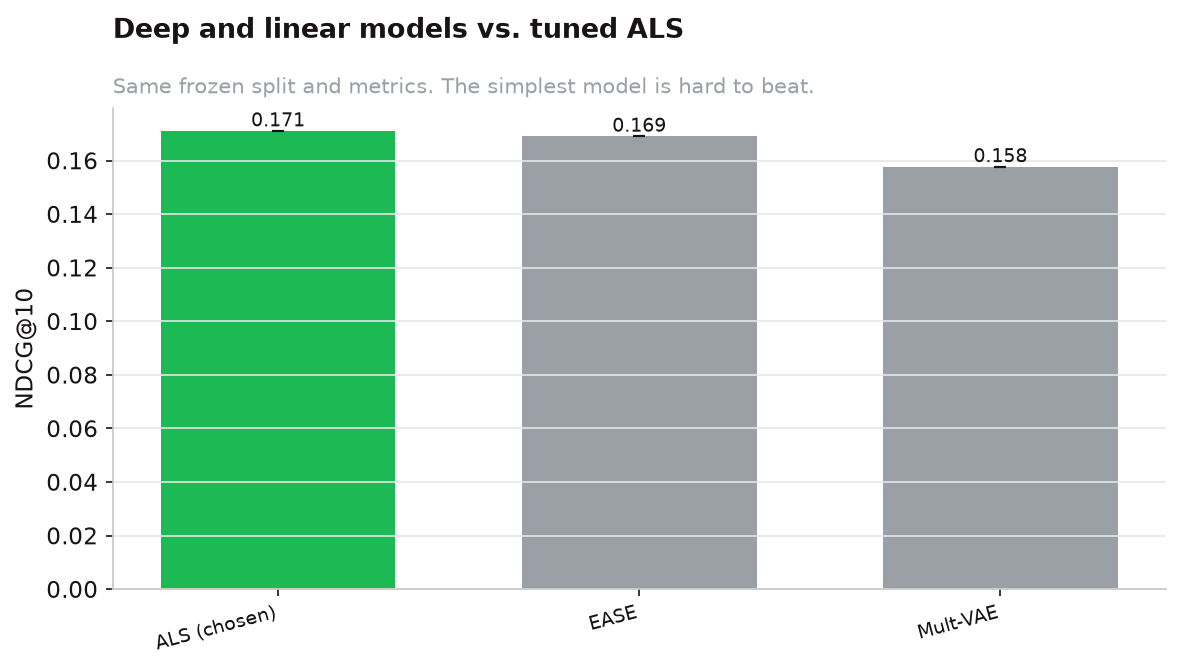
So in Phase 1 the served model was ALS (32 factors, log1p confidence), cheaper to train, cheaper to serve, and at least as accurate as anything more complex. Knowing when not to reach for deep learning was the point.
Phase 2, real data (Last.fm-360K)
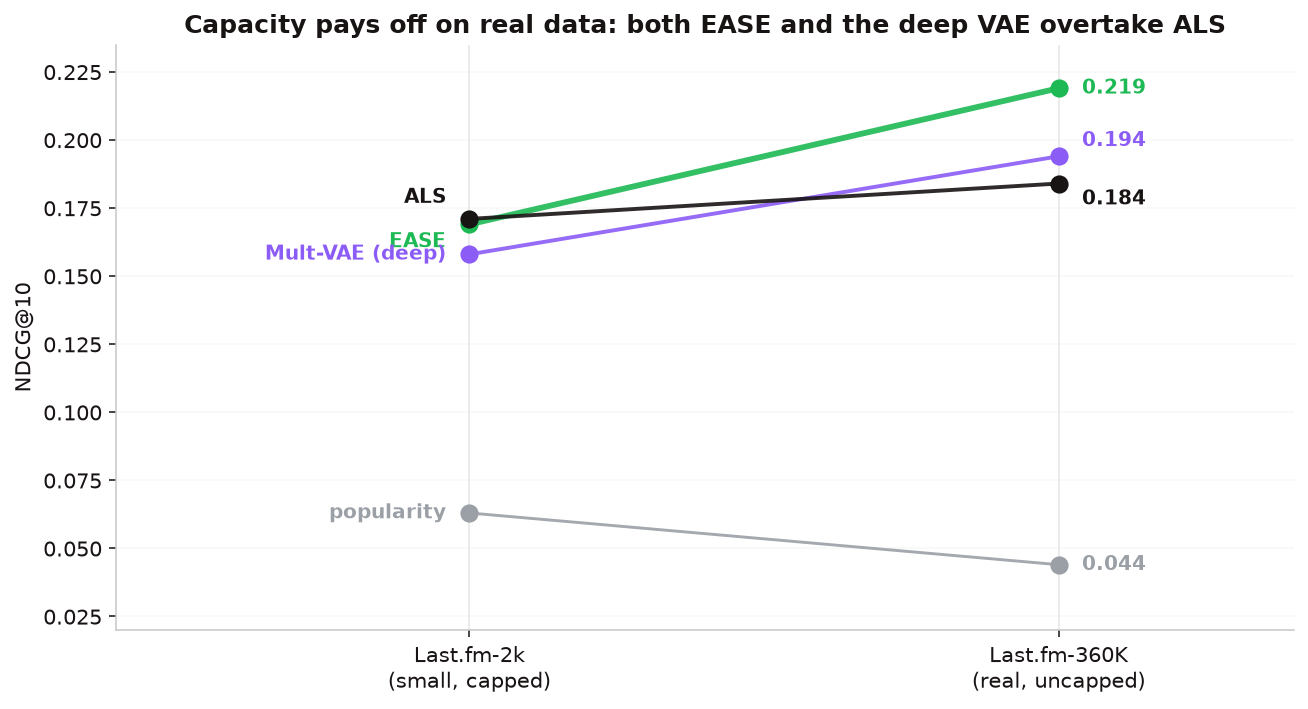
With 18× more interactions and real, uncapped histories, we ran the same comparison again. Capacity pays off, and the ordering changes:
| Model | NDCG@10 (2k) | NDCG@10 (360K) | on 360K |
|---|---|---|---|
| EASE | 0.169 | 0.219 | wins |
| Mult-VAE (deep) | 0.158 | 0.194 | overtakes ALS |
| ALS | 0.171 | 0.184 | |
| popularity | 0.063 | 0.044 |
Two things happen at once on real data. First, EASE’s extra representational capacity finally has enough signal to pay off, and it pulls significantly ahead of ALS (+0.036 NDCG@10, p < 0.001). It becomes the served model. Second, and more surprisingly, the deep Mult-VAE climbs from last to second: on 2k it lost to ALS, but on 360K it overtakes ALS (+0.010, p < 0.001). It still trails EASE (−0.026, p < 0.001), but the deep model went from “not worth it” to a genuine contender the moment the data was real.
Why this is the real story
Model complexity earns its keep only once there is enough data. The classic data-scale lesson, but here it is demonstrated rather than asserted, with a frozen harness and a significance test on both sides. The discipline is what lets us report two opposite winners without hand-waving.
The practical consequence for a portfolio: the deliverable is not “I trained EASE.” It is “I built an evaluation process trustworthy enough that it told me to change my mind, and I could prove the new answer was better.”